Why Do You Always Forget the Words You've Memorized? Use the Memory Curve to Store Them in Long-Term Memory
You've probably had this experience: you clearly memorized twenty vocabulary words yesterday, but when you flip open your book before today's quiz, you can't even remember half of them. Then you start to suspect that "your memory must be exceptionally bad."
Let me reassure you first: forgetting is normal; it's something that happens in everyone's brain. There is actually nothing wrong with your memory; the key lies in your "method" of memorizing. This article will use memory science to help you understand why you forget vocabulary words and how to memorize them so they truly stick in your brain.
The Forgetting Curve: After Learning, Memory Naturally Declines
In the 19th century, a psychologist named Ebbinghaus conducted an experiment and discovered something: after we learn something, our memory of it decays rapidly over time. It fades fastest on the first day after learning, then slows down, and finally, the small amount that remains becomes relatively stable. This downward-sloping line is called the forgetting curve.
In other words, forgetting is the brain's default mechanism. The brain receives a massive amount of information every day and automatically clears out things that "appear to be useless" to free up space for you. If the words you memorized don't appear again afterwards, the brain judges them as unimportant and lets them fade away.
So here is the key point: what you really need to do is make your brain believe that "this word is very important and needs to be kept."
Why Cramming a Lot at Once Actually Yields Poor Results
Cramming three hundred words the night before an exam, only to forget almost all of them after the test the next day—this is a path almost every student has walked.
The reason is that things crammed in at the last minute only stay in your short-term memory. Short-term memory is like a sticky note: it has a small capacity, doesn't last long, and falls off after a brief stick. If you cram too much at once, the brain doesn't have time to move them into long-term memory, which can preserve things for a long time. The result is "easy come, easy go."
A truly solid memory needs time to slowly "consolidate." This is also why memorizing in small, regular amounts is far more useful than cramming a massive amount all at once.
Spaced Repetition: Reviewing Just When You're About to Forget is the Most Effortless
Since memory naturally declines, the solution is intuitive: review it just when you are about to forget it, but haven't completely forgotten it yet. This is spaced repetition.
Its magic lies in this: every time you review, the forgetting curve becomes flatter, and you can hold onto it longer next time.
- First time: You might need to review after a day or two.
- After reviewing once: You might be able to last four or five days.
- Reviewing again: You can last one or two weeks.
- After a few rounds: This word moves into your long-term memory, and you will barely ever forget it.
As the review intervals stretch longer and longer, you exert less and less effort, yet remember things more and more firmly. Compared to re-memorizing all words every day, spaced repetition allows you to take action only at the "just in time" moments, saving time and staying effective.
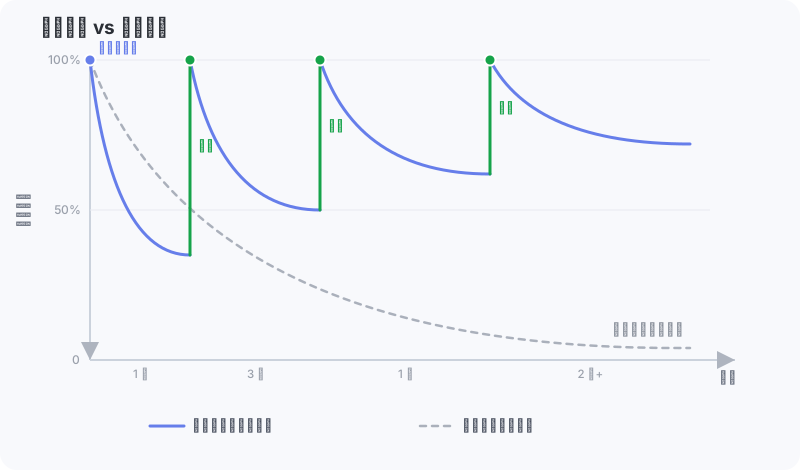
Above image: The grey dashed line represents "no review," where memory drops very low within a few days; the blue line represents "spaced review," where each review (in green) pulls memory back to its peak, with the curve getting flatter and the intervals stretching longer each time.
Tip: Reviewing right at the moment when you are "about to forget" yields the best results. Reviewing too early (when you still remember it clearly) is a bit of a waste; reviewing too late (when you've completely forgotten) is equivalent to relearning.
Active Recall: Think First, Then Look at the Answer
The way many people review vocabulary is to look at the word and its translation together over and over again. It looks diligent, but the effect is limited because the brain is only "recognizing," not truly "retrieving."
A more effective approach is called active recall: when you see a word, cover the answer first, make an effort to think of the meaning yourself, and then check it after thinking.
- When you see apple, first think to yourself, "What does this mean?", and then confirm once you've thought of it.
- If you can recall it: Congratulations, this memory has been strengthened once again.
- If you can't recall it: That's okay, this is exactly telling you, "This one needs more practice."
The very action of "trying to recall" is telling your brain, "I need to use this information, please keep it for me." Even if you guess wrong, this practice is more useful than simply rereading. The effort spent recalling is the strength that makes the memory stick.
Putting Words into Sentences Sticks Better Than Memorizing Isolated Words
Memorizing an isolated bright makes it easy to blur out the next day. But if what you memorize is a sentence:
- The sun is very bright today. (The sun is very bright today.)
This word immediately has an image, a context, and you learn how to use it along the way. The brain remembers things that are "meaningful and connected" particularly well, while lonely, isolated words are actually the hardest to retain.
Let's look at another example:
- She is a kind person. (She is a kind person.)
Rather than rote-memorizing "kind = kind," putting it into this sentence allows you to memorize the meaning, part of speech, and real usage all at the same time. One word paired with one example sentence is equal to learning three things at once. Next time you want to use it, the entire sentence will help bring the word out with it.
So when organizing your vocabulary notebook, writing down the sentences together with the words will make them stick much better:
- When memorizing kind, write down She is a kind person. ✓
- Writing only
kind = kind✗ (Isolated, no context, forgotten the fastest)
Summarizing the Method in a Single Sentence
If you can only remember one thing from the above, let it be this:
Small amounts, consistency, think before you look, and put words into sentences.
Cramming at the last minute is going head-to-head with the forgetting curve, which is destined to be strenuous and ineffective. Spending ten minutes every day recalling a few words at the right time is working with the brain's natural tendencies—easy and long-lasting. When it comes to memory, small, consistent steps far outperform occasional massive efforts.
How to Practice in Loopy
Calculating spaced repetition on your own is very troublesome—which word should be reviewed today, and which can wait a week? This is exactly what Loopy's memory curve does for you.
- For every word you learn, Loopy records your level of mastery and automatically schedules the timing for your next review, catching you right at the moment you are about to forget—making it effortless and highly retentive.
- Reviews employ active recall: you are first asked to recall the meaning before the answer is revealed, with every recall deepening your memory.
- All words live within sentences and listening contexts from real courses, encountered naturally again and again through listening, speaking, and shadowing, rather than just memorizing a list.
All you need to do is follow the regularly appearing review reminders and practice a little bit every day, leaving the timing of the rest to the memory curve. After a week or two, you will find that those words you used to forget right after memorizing have quietly settled into your long-term memory.
Starting today, swap "memorizing intensely once" for "reviewing regularly many times," and you will remember things much better than you imagine.